
Epoxy Removal Sydney
Specialist epoxy removal across Sydney. We mechanically strip epoxy, polyurethane, polyaspartic, flake and metallic coatings of any thickness with planetary diamond grinders and HEPA dust extraction — leaving a clean, correctly profiled slab ready for re-coating, grind & seal or polished concrete.
- 5-Star Google Rated
- Fully Insured
- Dust-Controlled Grinding
- Satisfaction Guaranteed
- Residential • Commercial • Industrial
About this service
Epoxy is designed to bond permanently to concrete — which is exactly what makes it so difficult to remove once it fails. Peeling, blistering, delaminating, chalking or yellowed epoxy cannot simply be coated over. Any new system applied on top of a failing coating inherits the same weak bond and fails again in the same places, usually within months. The only reliable fix is complete mechanical removal back to sound concrete.
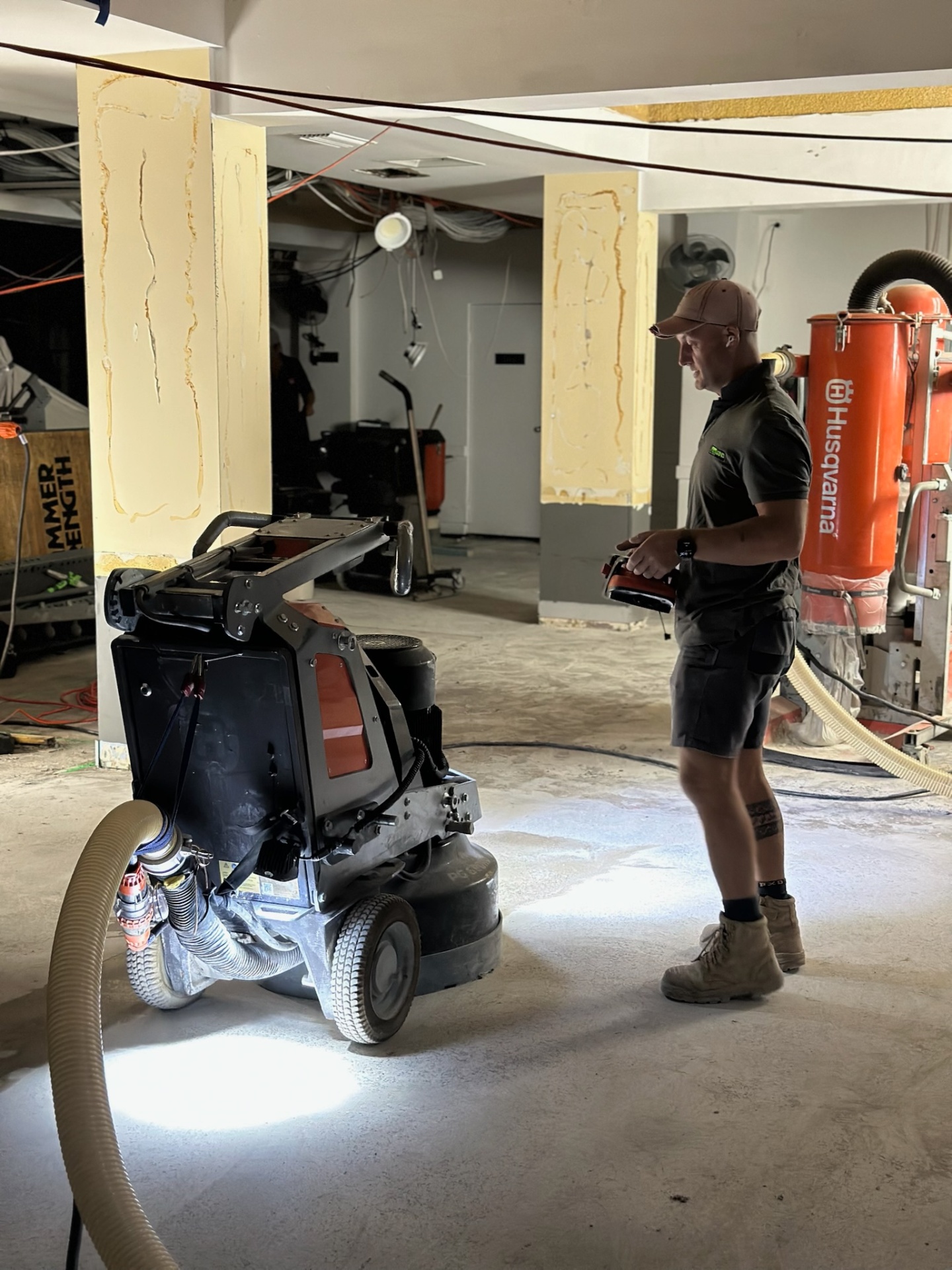
Ausgrind removes epoxy coatings mechanically, using heavy planetary grinders fitted with PCD (polycrystalline diamond) tooling for bulk stripping and metal- and resin-bond diamonds for refinement. PCD cutters shear the coating off the slab rather than smearing it, which is critical with soft, gummy or heavily filled epoxies that clog conventional segments. Once the bulk of the coating is off, we step down through finer tooling to remove residual resin from the surface pores and leave the concrete at the surface profile the next system requires.
We remove every common coating type found on Sydney floors: two-pack epoxy, water-based epoxy, high-build and self-levelling epoxy, epoxy flake systems, metallic epoxy, polyurethane, polyaspartic, epoxy primers and residues, industrial line markings and floor paints. Thickness is rarely the obstacle — from a 200-micron sealer coat through to 4–6 mm self-levelling industrial systems, it comes off. Thickness only affects how many passes it takes, and therefore the price.
Everything is done without chemical strippers. Solvent-based strippers are slow, produce hazardous waste, saturate the slab, leave residues that interfere with the bond of the next coating, and still require a mechanical grind afterwards to meet manufacturer specification. Diamond grinding removes the coating and creates the new profile in one operation, with no fumes, no flash points and no waiting for solvents to evaporate.
Dust is captured at the source. Every grinder runs to a HEPA-filtered industrial extractor capturing 99.97% of particles down to 0.3 microns, so removal work can proceed in occupied homes, tenanted offices, operating warehouses and strata buildings without shutting the space down or contaminating adjoining areas. This matters more with epoxy than with bare concrete — coating dust is fine, sticky and travels.
Once the slab is stripped we can hand it over to your coating contractor at a specified CSP, or continue straight into the finish ourselves — a new epoxy or polyurethane system, a grind & seal, or full mechanically polished concrete. Doing removal and finish with one crew removes the finger-pointing that happens when a new coating fails over someone else's preparation.
Why choose this service
- Removes epoxy of any thickness — thin coats through to 6 mm self-levelling systems
- 100% mechanical — no chemical strippers, fumes or hazardous residue
- PCD tooling strips soft, gummy and flake coatings without clogging
- HEPA dust extraction — safe for occupied homes, offices and tenancies
- Slab handed over at the CSP your next coating manufacturer specifies
- Removes flake, metallic, polyurethane and polyaspartic systems too
- Line markings, primers and epoxy residue fully removed
- Same crew can re-coat, grind & seal or polish the slab afterwards
- Fixed written quotes after a free on-site assessment
- Fully insured, Sydney-wide, residential, commercial and industrial
Where we use it
- Failed or peeling residential garage epoxy and flake floors
- Tired metallic epoxy in homes and showrooms
- Commercial kitchen, bakery and food-preparation coatings
- Warehouse, factory and workshop floor coatings
- Retail and showroom fit-outs and strip-outs
- Mechanical bays, car parks and service areas
- Pool surrounds, balconies and alfresco coatings
- Gyms, studios and hospitality venues
- Line marking and safety-coating removal
- Epoxy primer and residue removal before polishing
What we remove
Every coating behaves differently under the machine. Tooling, machine weight and pass count are matched to the system on your slab.
Two-pack epoxy
The most common coating on Sydney garages, workshops and commercial floors. Removed with PCD tooling, then refined with diamonds to clear resin from the surface pores.
Epoxy flake systems
Vinyl flake broadcast into an epoxy base with a clear top coat. Thick, layered and often gummy — PCD cutters shear it off cleanly where standard segments clog.
Metallic epoxy
Pigmented metallic systems leave colour in the concrete pores if under-ground. We continue past bulk removal until the slab reads as clean, untinted concrete.
High-build & self-levelling epoxy
Industrial systems from 1 mm to 6 mm thick. Removed in staged passes with aggressive tooling before the slab is profiled for the next system.
Polyurethane & polyaspartic
Tougher and more elastic than epoxy, so they need more passes. Common on car parks, commercial kitchens and modern garage finishes.
Paint, primers & line markings
Acrylic floor paints, epoxy primers, sealer residues, safety coatings and line markings ground off in isolated strips or across the whole floor.
Removal methods compared
Diamond and PCD grinding is the only method that removes the coating completely and creates the profile for the next system in one operation.
PCD grinding (our method)
Polycrystalline diamond cutters shear the coating off the slab instead of smearing it. Fast on thick and soft systems, no chemical residue, dust captured at the source, slab trafficable immediately.
vs Chemical stripping
Slow, produces hazardous waste, saturates the slab and leaves residues that interfere with the next coating's bond — and a mechanical grind is still required afterwards to meet specification.
vs Shot blasting
Effective on large open industrial slabs but struggles with soft, gummy and elastic coatings, can't reach edges or tight areas, and leaves a coarse tracked profile.
vs Scarifying
Removes heavy build quickly but gouges the slab, leaving damage that must be filled before most coatings can be applied. Reserved for extreme thickness only.
vs Sanding or wire brushing
Nowhere near enough cutting power for cured epoxy. Polishes the coating rather than removing it and wastes time and consumables.
vs Coating over the top
The cheapest option today and the most expensive one within a year. A new system bonded to failing epoxy delaminates in exactly the same places.
CSP levels explained
Once the coating is off, the slab is ground to the Concrete Surface Profile your next system specifies under ICRI guideline 310.2R. Hit the specified profile and the new system bonds; miss it and the warranty is void.
- CSP 1 – CSP 2
- Light profile from a fine diamond grind. Suited to thin-film sealers, penetrating sealers and some self-levelling underlayments.
- CSP 2 – CSP 3
- The most common profile in Sydney. Standard for two-pack epoxy, polyurethane and moisture-barrier systems up to around 1 mm build.
- CSP 3 – CSP 4
- Aggressive metal-bond grind for high-build epoxy, flake systems and heavy-duty coatings from 1–3 mm.
- CSP 4 – CSP 5
- Deep profile for self-levelling epoxy, industrial screeds and trowel-applied systems over 3 mm.
- Adhesive removal
- PCD tooling strips carpet glue, vinyl adhesive, mastic and tile beds back to sound concrete before final profiling.
- Laitance removal
- The weak cement-rich surface layer and curing compound removed so bonding is to the structural slab, not the skin.
What happens to the slab next
Removal is rarely the end goal. We can hand the slab over profiled and documented, or take it straight through to a finished floor with the same crew.
New epoxy or polyurethane
Slab profiled to CSP 2–4 to the coating manufacturer's specification, with all resin residue cleared so the new system bonds to concrete rather than to old coating.
Grind & seal
A cost-effective way to turn a stripped slab into a finished floor — the concrete is exposed to your chosen aggregate level and sealed in matte through to high-gloss.
Polished concrete
Where the slab quality allows, mechanical polishing turns the bare concrete into the finished surface — no coating to fail again and decades of service life.
Tile, vinyl or timber
Slab flattened, residue removed and handed over at the tolerance and cleanliness the installer's adhesive requires.
Bare, sealed concrete
For workshops and warehouses that just need a clean, dust-proofed slab, we densify and seal without a topical film.
Handover to your contractor
We can strip and profile only, then hand the floor over at a documented CSP so your coating contractor takes it from there.
Residential, commercial & industrial
Residential
- Garages and basements
- Homes and renovations
- Driveways and pathways
- Patios and alfresco areas
Commercial
- Retail tenancies and fit-outs
- Offices and workspaces
- Restaurants, cafés and hospitality
- Shopping centres and showrooms
Industrial
- Warehouses and distribution centres
- Factories and manufacturing
- Workshops and mechanical bays
- Cold rooms and food production
How we deliver
- 01
Free on-site assessment
We inspect the coating, test its adhesion and thickness, identify the system (epoxy, PU, polyaspartic, flake or metallic) and confirm what the slab beneath is likely to look like once it's off.
- 02
Fixed written quote
You receive a fixed per-square-metre price covering removal, dust control and the agreed handover profile — no hourly rates and no variations unless the scope changes.
- 03
Site setup and protection
Walls, joinery, thresholds and adjoining rooms are masked and protected. Power, water and access are confirmed, and dust extraction is positioned before any grinding starts.
- 04
Test patch
A small area is stripped first to confirm tooling selection and grinder configuration. This sets the pass rate for the whole floor and avoids gouging soft slabs.
- 05
Bulk coating removal
PCD tooling under heavy planetary grinders shears the bulk of the coating off quickly. Multiple passes are used on high-build and self-levelling systems.
- 06
Edge and detail work
Dedicated hand and edge grinders take the coating right up to skirtings, door frames, columns and around penetrations where the planetary machine can't reach.
- 07
Residue and pore cleaning
Finer metal- and resin-bond diamonds remove resin left in the surface pores. This step is what separates a slab that looks clean from a slab that actually is clean.
- 08
Profiling to spec
The slab is ground to the CSP your next system requires — typically CSP 2–3 for standard epoxy, CSP 3–4 for high-build, or a fine profile for polishing or sealing.
- 09
Repairs if required
Spalls, pop-outs, divots and cracks exposed by the removal are patched and stitched so the new finish sits on a sound, continuous surface.
- 010
Clean handover
The floor is vacuumed, inspected with you and handed over dust-free, trafficable immediately and ready for the next coat, sealer or polish.
At a glance
- Coatings removed
- Epoxy, water-based epoxy, high-build, self-levelling, flake, metallic, polyurethane, polyaspartic, floor paint, line marking
- Thickness range
- Thin-film sealers through to 4–6 mm self-levelling industrial systems
- Method
- Mechanical PCD and diamond grinding — no chemical strippers
- Equipment
- HTC and Husqvarna planetary grinders, PCD cutters, edge grinders
- Dust control
- HEPA extraction at source — 99.97% of particles to 0.3 microns
- Handover profile
- CSP 1 – CSP 5 to the coating manufacturer's specification
- Typical turnaround
- Single garage 1 day; 100–200 m² 1–3 days; larger areas staged
- Trafficable
- Immediately after removal — no cure or flash-off period
- Next steps available
- Re-coat, grind & seal or full polished concrete by the same crew
- Coverage
- Greater Sydney — residential, commercial and industrial
What it costs
Epoxy removal in Sydney is priced per square metre, and the single biggest driver is what's on the slab rather than how big it is. A thin, already-failing flake coat that releases easily sits at the lower end, while a well-bonded high-build or self-levelling epoxy 3–6 mm thick can take several times as many passes and correspondingly more tooling. As a guide, most residential removals fall between roughly $30 and $60 per m², with light delaminating coatings lower and heavy industrial systems higher. Small areas carry a minimum charge because mobilisation, setup and dust control cost the same on 20 m² as they do on 200 m². We attend site free of charge, test the coating, confirm the profile your next system needs and issue a fixed written quote — so there are no hourly rates, no surprises and no variations unless the scope itself changes.
Final pricing depends on:
- Total square metres
- Coating type (epoxy, flake, metallic, polyurethane, polyaspartic)
- Coating thickness and number of layers
- How well the coating is still bonded
- Concrete hardness and slab condition
- Surface profile (CSP) required for the next system
- Number of rooms, corners, edges and stairs
- Repairs and patching exposed by the removal
- Site access, parking and lift availability
- Out-of-hours or staged programming
- Waste removal and disposal
Why customers pick us
- Specialist PCD tooling — we strip coatings other grinders smear and clog on
- No chemical strippers: safer for your family, staff, tenants and the environment
- True HEPA extraction means we can work in occupied and tenanted buildings
- We hand over at the CSP your coating manufacturer actually specifies
- One crew can remove the old coating and install the new finish — no blame-shifting
- Fixed written quotes after a free on-site assessment
- Fully insured and experienced across residential, commercial and industrial sites
- Based in Epping, servicing Greater Sydney including the Blue Mountains
Recent projects
Sydney-wide coverage
We service all of Sydney for epoxy removal — including:
Common questions
Ready to transform your concrete?
Whether it's a single garage or a 5,000m² warehouse, Ausgrind delivers reliable communication and a high-quality finish. Speak to Nico & Craig directly.
Request a Free On-Site Assessment
Free, no-obligation quote. We respond within 1 business day.